
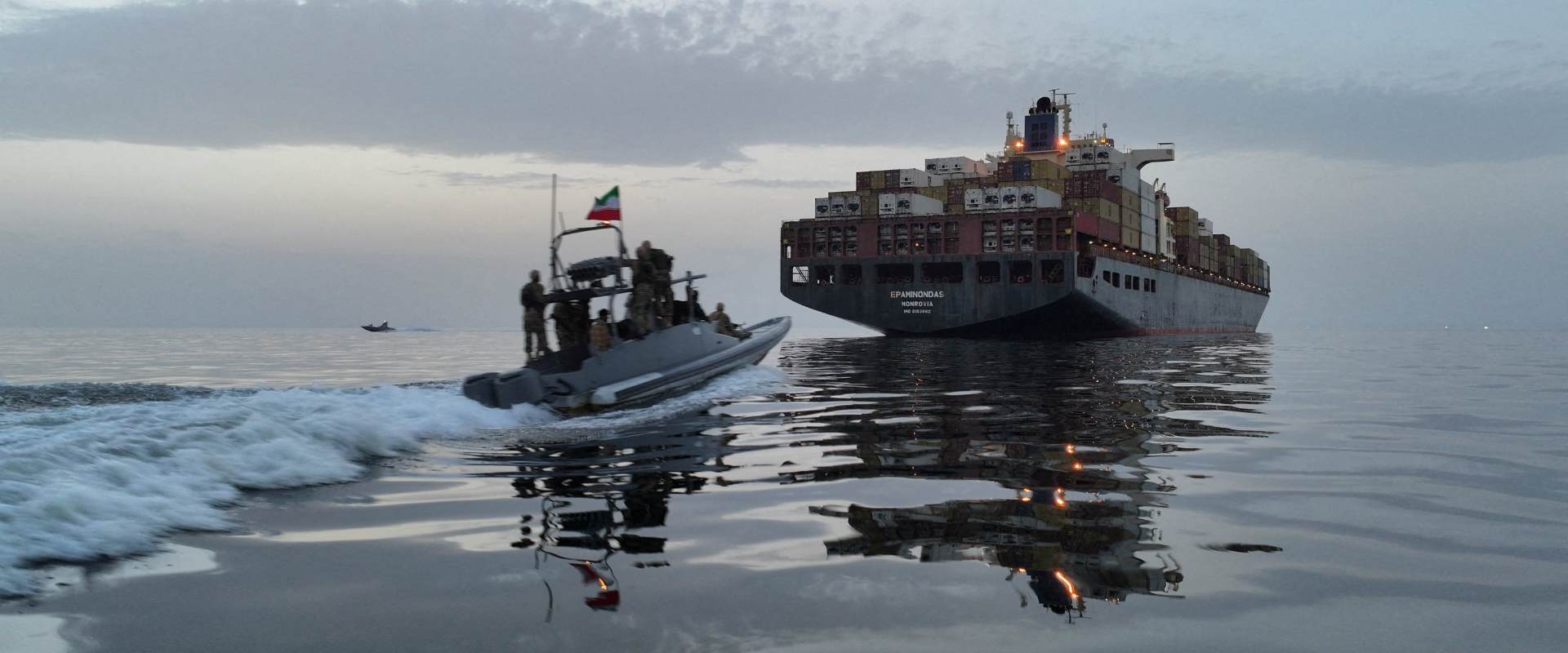

The attack on Iran by the United States and Israel has demonstrated the viciousness of Western imperialism in a new period, as well as the limits of its capacity. The initial bombing campaign, in which dozens of government officials, including Ayatollah Ali Khamenei, were killed, seems to have been imagined by the Donald Trump administration as a rerun of their “chop off the head” operation in Venezuela. Its failure has instead shown the world that the US is in fact not all-powerful. The Iranian shutdown of the Strait of Hormuz, attacks on neighboring US bases and allies, and the entrenchment of the regime have demonstrated that the US cannot freely impose its will wherever and however it likes.
At the same time, the recklessness of the attack itself and Trump’s antagonism toward longtime US allies is accelerating the development of a new stage of imperialism, breaking with the soft-power arrangements predominating since the end of the Cold War and threatening the entire planet with military, economic, and political catastrophe.
The Trump administration is rapidly rearranging the field of geopolitics. Trump’s unilateral violence and constantly shifting bombastic redefinitions of reality have not only isolated the US from formerly supportive regimes but have also made it practically impossible for most nations to ally with him, because it is never clear exactly what direction Trump will steer in any given week.
The fundamental starting point for communists remains the same: agitating and organizing for the defeat of the US, the Zionist entity, and their allies in every circumstance.
The constant, mercurial violence of the Trump administration represents both a rupture in US foreign policy and a continuity of certain priorities. The new contours emerging will reshape what forms imperialism will take in the coming period, as well as the approaches needed from anti-imperialists. The fundamental starting point for communists, however, remains the same: agitating and organizing for the defeat of the US, the Zionist entity, and their allies in every circumstance.
The Trump difference
Since the beginning of Trump’s political career, it has been commonplace for liberal commentators to describe him as a deranged exception to the politics-as-usual of the US. In general, socialists have challenged this conception. It is not because of Trump’s personality that the US has a network of concentration camps, massive rollbacks of even the most basic civil liberties, and political power increasingly concentrated in a small coterie of billionaire capitalists.
All of these are features of the politics of the US as the world’s leading capitalist power. Attributing them to the many defects of Trump’s personality — or malignant narcissism and frontotemporal dementia — lets off the hook the political establishment as a whole. The Obama and Biden administrations, for example, massively expanded the power and resources of ICE, handing Trump in each of his presidencies a better-funded and more dangerous secret police force. Every administration in living memory, from those run by Democrats to the more supposedly reasonable Republican ones, has bombed at least one country.
While Trump’s management of the empire doesn’t set his administration outside the logic of imperialism generally, it does represent a change in strategy. US imperialism is entering a new period.
However, it is apparent that at least some of the differences in the US approach to foreign policy in Trump’s second term are due to the peculiarities of Trump’s approach. The constantly advancing and retreating brinksmanship and the apparent belief that public statements can define the reality of material situations differ from the usual bluster and bullshit of the capitalist state. The status of various proposed, imagined, or actual ceasefires; the strength or weakness of the Iranian military; and the continually shifting desire for the opening or closing of the Strait of Hormuz all demonstrate a particularly volatile approach to the administration of empire.
Shifting geopolitical priorities
While Trump’s management of the empire doesn’t set his administration outside the logic of imperialism generally, it does represent a change in strategy. US imperialism is entering a new period.
Since at least the 2008 financial crisis and its long aftermath, the capitalist class has been struggling to resolve a series of crises of political and economic legitimacy. The global system of neoliberalism that had prevailed since the 1970s is no longer as effective in generating new markets through the privatization and financialization of public services, reinforced by pressure from international financial predation. The accompanying world order, with the US using a system of soft power bolstered by occasional direct military action, has more recently been challenged by the rise of other powers, especially Russia and China.
The Trump administration has made clear a new approach to imperialism. The administration is foregrounding the politics of far-right figures like Stephen Miller, who, until only a few years ago, were well outside the mainstream, on the level of neo-nazi websites and niche reactionary think-tanks. This set of politics is most akin to every racist uncle who ever wondered aloud why “we” didn’t bomb every majority-Muslim country into dust after 9/11.
Brought into the administration of the most dangerous empire on Earth, this political orientation appears as a flurry of reckless threats to invade and destroy a series of countries, with enough actual attacks that none of the threats can be taken lightly. The administration has threatened to annex Canada, invade Greenland, and use Spanish air bases with or without the permission of the Spanish state. In addition to these so-far-empty threats, it has also attacked Venezuela, blockaded Cuba, and initiated a regional war with Iran.
George W. Bush’s “coalition of the willing” was a fraud, but it was a fraud into which effort was put. The US believed it necessary at the time to present itself as the head of a reasonable, rational group of concerned nations. The Trump administration has abandoned even this thin pretense.
Since the coup attempt against Hugo Chavez’s government in 2002, the US approach to Venezuela has been to support US-friendly forces in the country and attempt to financially isolate the regime. In contrast, Trump opted for a sudden and direct action, abducting President Nicolas Maduro in a shock attack.
In June 2025, negotiations between the US and Iran were cut short when the Zionist entity, then the US, bombed Iranian nuclear facilities. And since February 2026, the US and Israel have assassinated leading Iranian negotiators, like Ali Larijani, the secretary of Iran’s Supreme National Security Council, and threatened others, like Iranian parliamentary speaker Mohammad-Bagher Ghalibaf and foreign minister Abbas Araghchi, by putting them on a kill list.
The message is clear: even in countries that have shown recent willingness to negotiate with the US, the prospect of sudden and spectacular violence is always on the table.
The apparent success of the operation against Venezuela, resulting in a cooperative regime and a show trial of Maduro in New York, provided early confirmation to the administration that the new strategy of surprise imperial adventures would work.
While the Venezuelan regime rules a country in which the mass support once enjoyed by Chavez has been hollowed out by years of neoliberal restructuring and the erosion of the economic and social gains that won that support, making it more easily incorporated into the new US colonialism, the Iranian state is another entity altogether. While facing mounting protest movements over the last decade, Iran is much more firmly in control of its population and economy, to the point of acting as a minor imperialist power in the region.
The initial failure of the US to immediately topple the Iranian regime has led to a very Trumpian moving of goalposts. The Iranian military is somehow both the biggest threat to the world and also completely destroyed, negotiations both are and aren’t happening, Trump demands that the European Union help reopen the Strait of Hormuz but doesn’t need it, and the US is either committed to the war crime of destroying all of Iran’s civilian infrastructure or to making a deal.
In this context, Trump has eliminated even the pretense of building an international consensus to support his aggression. George W. Bush’s “coalition of the willing” was a fraud, but it was a fraud into which effort was put. The US believed it necessary at the time to present itself as the head of a reasonable, rational group of concerned nations. The Trump administration has abandoned even this thin pretense.
Continuities within the rupture
At the time of the US invasion of Iraq, there was a widely reported joke made by hawkish GOP politicians and staffers that went, “Anyone can go to Baghdad. Real men go to Tehran.”
Conquest of Iran was plainly on the mind of the most hardline members of the imperialist government in 2003, as it had been since the revolution in 1979. The revolution — during and after which the current reactionary Iranian regime consolidated power on the blood of the more progressive revolutionary elements — represented a serious defeat for the US. In 1953, the US had committed to the overthrow of an elected government and the installation of a compliant one under Shah Mohammad Reza Pahlavi. Its interests in the region were significantly set back when the Shah was deposed. Until now, every US administration has declined to use direct military force, but re-conquering Iran has been their constant goal.
The claim that Israel dictates the policy of the empire, or dragged the US into conflict with Iran against its better judgment, does nothing to explain the actual dynamics at play. Rather, it covers up the US’s role as the dominant imperialist power in the world.
The Trump administration’s attack is therefore in line with longstanding US ambitions and interests, even as it breaks from the strategy previously in place. The same is true of the blockade of Cuba and the attack on Venezuela. The difference here is one of strategy, not of purpose.
The strongest continuity between this administration and previous ones lies in the violence unleashed by the Zionist client state occupying Palestine. This newest stage of escalation began, of course, under the Biden administration, which fully supported the intensification of the ongoing genocide after the October 7 jailbreak and viciously suppressed the Gaza solidarity encampment movement on US campuses. That suppression continues under Trump, and has indeed expanded.
No coalition, none willing
The Palestine movement has shifted political opinion in the US more than the inflexible support for the Zionist project by both capitalist parties would suggest. The protestors’ plainly accurate objections to the live-streamed slaughter, together with the violent suppression of nonviolent campus protests, has made clear to a wider section of the US population than ever that the Zionist project is a bipartisan policy of brutality and violence. This has accelerated the decline in support for Israel, particularly among younger people, including the dramatic decrease in identification with the Zionist state among young Jewish people.
This immediate context would have undermined the Trump administration’s effort to build support for its attack on Iran had any such efforts taken place. As it happened, it has contributed to the unpopularity of the war against Iran. In contrast to other imperial adventures, there has been little domestic or international support from the beginning. Even segments of Trump’s MAGA base have begun to break with him over the war, with conservative pundits and influencers searching for an angle less dependent on the president for their grift.
The limitations of US imperialism have been demonstrated, and it is now committed to reinforcing itself as the premier practitioner of mass violence in the world. The consequences for the people of Iran promise to be devastating.
More importantly, there have been reports of growing opposition and even sabotage from within the military to avoid deployment. These reports are made all the more credible by details of how the US has been stretched unexpectedly thin by the war, from depleted stores of materiel to the insufficient rations served to sailors deployed around Iran. While the US will eventually refill its armories and bolster its supply lines, the situation further emphasizes that it has been stretched to near the limits of its capacity. A military staffed by hungry soldiers on extended tours in an unpopular war will only experience more internal resistance over time.
Across the board, the Trump administration’s approach has prevented it from weaponizing the deeply rooted culture of jingoism that has historically been a reliable tool of the capitalist class.
Joint imperialist venture
The apartheid state of Israel acts as the US’s agent in the Middle East region. It carries out its violence with the explicit political, economic, and military support of the US. The claim that Israel dictates the policy of the empire, or dragged the US into conflict with Iran against its better judgment, does nothing to explain the actual dynamics at play. Rather, it covers up the US’s role as the dominant imperialist power in the world and its willingness to sponsor terror to protect its interests.
That is not to say that the interests of the two countries are always identical. While the Trump administration negotiated its first farcical cease-fire, Israel continued to carry out its bombardment of southern Lebanon, leveling entire towns and issuing warnings not to shelter Shiite Muslims, in an approach that is sickeningly familiar to anyone who has paid attention to other genocides.
In short, while Israel continues to act as the US’s attack dog in the region, dogs and their masters do not always have the same interests; they are aligned by a very specific arrangement. It is not at all clear that the Zionist state is on board with whatever the terms of the next potential ceasefire might be, nor that it will be bound by any agreement between the US and Iran.
What is clear is that, whatever Trump is saying on a given day, the Zionist state is actively and brutally pursuing its agenda of leveling as much of the region as it can to pursue its longstanding project of genocidal settlement. Though their specific goals may differ, the US can be broadly expected to support Israel, as ever.
What kind of defeat?
The erosion of domestic support for the genocide in Palestine is not the only area in which the US is facing a loss of credibility. The failure of the first stage of the US war on Iran — the surprise attack that killed thousands yet left the regime in place — was rightly understood by anti-imperialists around the world as a welcome setback for US imperialism. “The best, most powerful, most lethal fighting force the world has ever seen” has been exposed as militarily incapable of defending “America’s puppet bases” in the Gulf states or ending Iran’s blockade of the Strait of Hormuz.
The clear failure of the latest US military operation was, even for hardened anti-imperialists who have never believed the empire to be unstoppable, a pleasantly surprising indication that the US can be defeated on the world stage.
The only force that can fully end the brutality of imperialism is the global working class. The only force that can end the oppression of the Iranian regime is the Iranian working class, which has been putting up an increasingly impressive fight in recent years.
In the immediate aftermath of the capitulation of the Venezuelan government, Iran’s attacks on the regional allies of the US were met in much the same way. Iran’s use of cheap drones to penetrate seemingly impenetrable defense systems, (systems that have been supported and funded by politicians as far left as supposedly socialist, DSA-backed Jamaal Bowman and Ilhan Omar), shows that the victory of US and Israeli imperialism and Zionism is not inevitable.
Developments since then have provided less cause for celebration. The conflict has settled into a familiar pattern, with the US grinding its way into a long war with Iran and focusing on inflicting the maximum possible civilian and infrastructural damage, in the hopes of winning an asymmetrical war of conquest.
The limitations of US imperialism have been demonstrated, and it is now committed to reinforcing itself as the premier practitioner of mass violence in the world. The consequences for the people of Iran promise to be devastating.
For the defeat of US imperialism
The only force that can fully end the brutality of imperialism is the global working class. The only force that can end the oppression of the Iranian regime is the Iranian working class, which has been putting up an increasingly impressive fight in recent years, in an escalating series of social upheavals led by feminist activists against the morality police and the regime itself. No matter what half-baked justifications are put forward by Trump and his ilk, themselves committed to the violent enforcement of gendered oppression and the state establishment of religion, nothing the US does will ever contribute to liberation in Iran.
The communist position on Iran must therefore be for the defeat of the US and Israel, for the military victory of Iran in its defense against imperial aggression, and for the victory of Iran’s exploited and oppressed in their struggle against the Iranian regime.
The ongoing conflict has only set back the movement against the Iranian regime by forcing it to operate on impossible political terrain, including mass arrests, lethal repression, and the imposition of the longest internet blackout in history. The choice faced by opponents of the Taliban regime in the context of the invasion of Afghanistan from 2001 onward provides a parallel example, albeit one in a much less developed country; when the empire is attacking your country, mounting a frontal attack on your own regime takes — by no fault of your own politics — a back seat to mobilizing against the invader.
The US attack has therefore weakened the position of the Iranian opposition and put the regime in a stronger position. Any reasonable observer should expect regime suppression of its enemies to increase in the coming months, as it digs in its heels against both the US and all internal opposition.
The communist position on Iran must therefore be for the defeat of the US and Israel, for the military victory of Iran in its defense against imperial aggression, and for the victory of Iran’s exploited and oppressed in their struggle against the Iranian regime.


