
The Moscow Trials, which so shocked the world, signify the death agony of Stalinism. A political regime constrained to use such methods is doomed. Depending upon external and internal circumstances, this agony may endure for a longer or shorter period of time. But no power in the world can any longer save Stalin and his system. The Soviet regime will either rid itself of the bureaucratic shell or be sucked into the abyss.
—Leon Trotsky, The Stalin School of Falsification
In our current moment, the crisis of capitalism has brought humanity to the ultimate crossroads: socialism or extinction. While we still aren’t at the doorstep of overthrowing capitalism, the symptoms of its decay and increasingly barbaric politics have escalated dramatically. By forcing a dramatic rightward shift in bourgeois politics and emboldening the far right, the potent stench of Trumpism has brought the rotten core of neoliberalism to light. In response to this rapid decay, political trends in social media and sensationalist “hot take” culture, coupled with media illiteracy and mysticism, have generated idealist speculation over what has gone wrong and why. Conspiracy theories continue to influence US political culture, especially in response to the empire’s decline and the lack of solutions offered by the capitalist class other than increased repression and austerity. This speculation has manifested in conspiracism on the far right and in other fringe circles. However, no one should assume that the left is immune to this either.
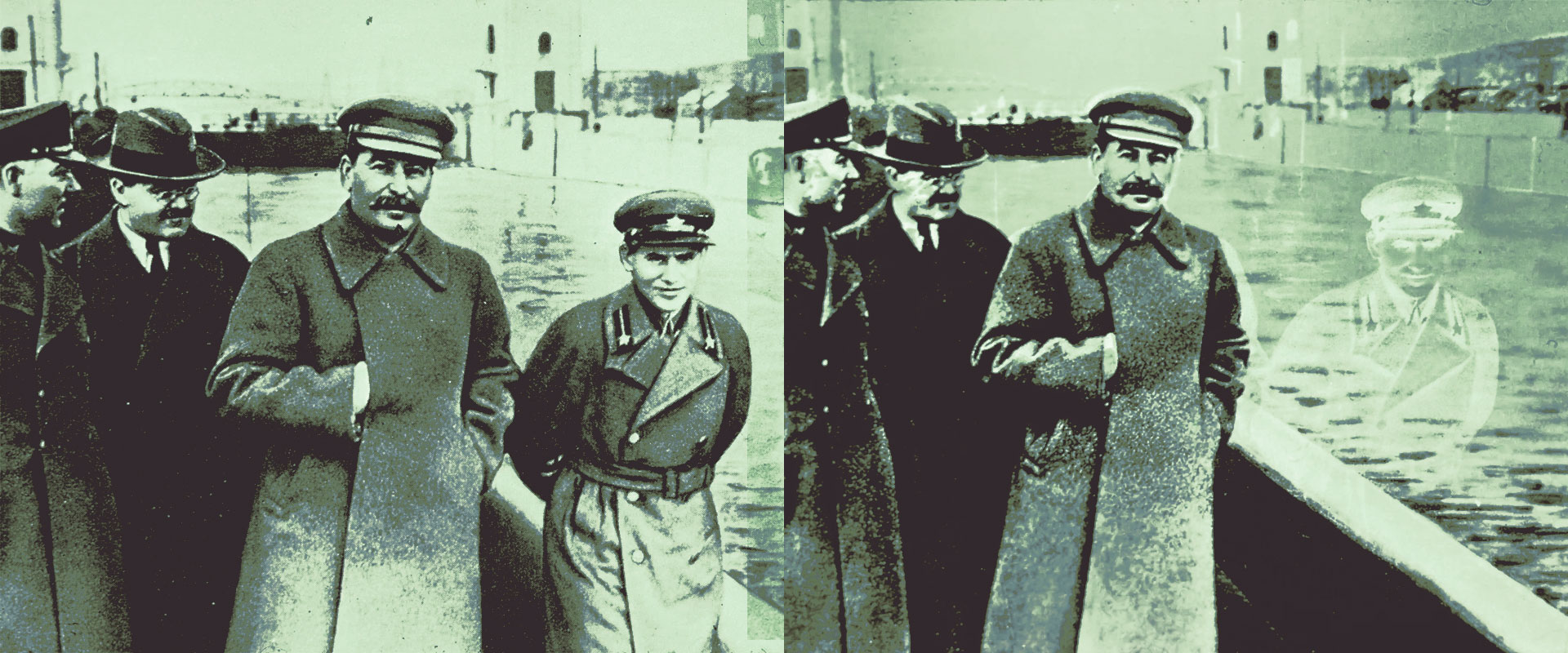
A very similar phenomenon was happening in the Soviet Union when Joseph Stalin was attempting to consolidate power in the 1930s. In response to a crisis of legitimacy caused by the economic and social consequences of rapid industrialization, forced collectivization of the peasantry, and the fanatical suppression of dissidents, the Soviet ruling class launched the Moscow Trials. The verdicts of these trials, which falsely painted Leon Trotsky and his comrades in the Left Opposition as fascist conspirators who wanted to see the USSR fail, have been upheld as truisms by Stalinists for decades. Marxist historian Doug Enaa Greene takes this tradition of historical falsification and conspiracy peddling to task in his illuminating 2025 book, In Stalin’s Shadow: Leon Trotsky and the Legacy of the Moscow Trials.
Stalinism’s lingering influence
Greene opens his book by identifying parallels between Stalinist conspiracism of the 1930s and contemporary conspiracism. Stalinist and other left-wing conspiracists have positioned their theories as grounded in empirical data and dialectics, while claiming that only right-wing conspiracy theories flow from reaction and bigotry. Greene demolishes this false dichotomy.
Conspiracy theories continue to influence US political culture, especially in response to the empire’s decline and the lack of solutions offered by the capitalist class other than increased repression and austerity.
The way in which Trotsky, born a Ukrainian Jew, was presented in the USSR as a maniacal cosmopolitan conspirator bore little difference from right-wing conspiracy theories that paint a wealthy Jewish elite as the true enemies of humanity. As Greene writes:
Among Trump supporters an entire cottage industry of conspiracy theorists has emerged in the QAnon movement. Their core belief is that a cabal of Satanic pedophiles and the ‘Deep State’ have conspired to thwart Trump’s agenda. In addition, there was a resurgence of alt-right and other neo-Nazi groups during the Trump years who have all promoted various antisemitic conspiracy theories. On the Stalinist left, there is a parallel conspiracism that sees Trotsky as a ‘bolt from the blue’ or a demonic figure representing the forces of evil.
While pointing out the sheer absurdity of claiming that the founder of the Red Army and defender of the Russian Revolution was somehow a “fascist collaborator” who merely wanted power for his own sake, Greene also emphasizes that these accusations profoundly impacted the communist movement at the time and continue to haunt it today.
In a recent interview, Greene described to me how the power and influence of the USSR in the past, coupled with the pervasive influence of Stalinist states and parties in the present, have lent credence to the show trials’ verdicts.
The reality is that when the Trials occurred, it’s important to note that the Communist Party of the Soviet Union (CPSU) ruled over one sixth of the Earth. Stalin had immense power, and he had allied parties in every corner of the world, often with mass membership. And even though I would argue that Trotsky had truth on his side, the forces supporting him were much fewer, and they really didn’t carry the same immense weight as the Stalinists throughout most of the 20th century. What was popularly known as “communism” was associated with the CPSU and its allied states, both within and outside of the Eastern Bloc, along with other Stalinist parties around the world. And there certainly was some questioning of the Stalin narrative by members of these parties after 1956 and the years that followed Stalin’s death with the release of Kruschev’s Secret Speech, and to some degree after the USSR fell in 1991. When the Soviet Union and Eastern Bloc collapsed, you could see this shift, depending on the Stalinist parties you’re looking at. But even to this day, the reason why I think the Stalin narrative does have immense pull is because there are still self-proclaimed socialist or “Marxist–Leninist” states with power and influence over the movement.
Greene goes on to explain some of the material reasons for Stalinism’s hold over the contemporary left:
To an extent, this influence is understandable, as everyone has largely been lied to about the Soviet Union and communism by bourgeois media, educational institutions, historians, politicians, etc., so they jump to an unapologetically pro-USSR/pro-Stalin concussion as they are radicalizing, e.g. “Stalin did nothing wrong” and “everything we’ve been told about him and the USSR in the 1930s was false! The Trial verdicts were absolutely correct!” I think that’s part of the reason it offers some compelling narratives, since there are anti-capitalist institutional reasons for it. And you do see these neo-Stalinist thinkers who think they’re pushing back against bourgeois distortion and Cold War propaganda by defending what they believe communism is, thereby falsely seeing a need to defend the most indefensible and worst aspects of Stalinism.
The ruling classes in Stalinist states have always prioritized maintaining their own power, even when that entails falsifying history to depict all critics as counter-revolutionary apologists for Western imperialism. Historical support for the USSR has metastasized into contemporary campism: left-wing support for states that posture as anti-imperialist while maintaining their own imperialist aspirations built on the exploitation and oppression of workers, national minorities, women, and LGBTQ+ people.
The Stalinist ruling class perfected the art of painting themselves as opponents of Western empire while robbing the Soviet people of all political, social, and economic power, and Stalinism’s unapologetic defenders continue to cling to this false notion.
The appeal to historical “necessity”
Even though Trotsky acquitted himself admirably against all accusations, Stalinists continue to believe that the Moscow Trials’ verdicts were valid. They regularly cite writings by Stalin’s loyal defenders, including Domenico Losurdo, Ludo Martens, Bill Bland, and Grover Furr, who claim that Stalin’s political opponents were playing into the hands of the USSR’s bourgeois anti-communist rivals, regardless of their political orientations. In defending the authentic revolutionary Marxist tradition, Trotskyists in particular have been the target of this vitriol for close to 100 years. However, notwithstanding their shared hostility towards Trotskyism, each of these authors has their own approach to defending Stalin’s legacy.
Throughout In Stalin’s Shadow, Greene effectively addresses the differences between these authors. While hardline Stalinists like Furr, Bland, and Martens have claimed that Stalin and his circle did nothing wrong, Losurdo attempted to apply a dialectical lens to the Great Purges and Moscow Trials by pointing to their “historical necessity.”
In a number of works, most notably Stalin: The History and Critique of a Black Legend (2008), Losurdo claimed that Stalinism was a historical necessity for the USSR since it represented political realism. He argued that revolutions must pass through the stages of “utopianism” to “realism” if they are to survive. Following Hegel’s analysis of the French Revolution, Losurdo stated that this event underwent a “Dialectic of Saturn” when it shifted from Jacobinism to Thermidor and Bonapartism.
Contemporary Stalinists cite this distorted version of dialectical materialism to justify the horrific repression and mass hysteria under Stalin. Not only does Losurdo deviate from Marxist dialectics, he relies on a rigidly dogmatic and determinist method that doesn’t account for the continuous motion of history, especially revolution.
Historical support for the USSR has metastasized into contemporary campism: left-wing support for states that posture as anti-imperialist while maintaining their own imperialist aspirations built on the exploitation and oppression of workers, national minorities, women, and LGBTQ+ people.
In order to survive, a socialist revolution does not require repressive laws and institutions that disempower the very masses who made the revolution in the first place. On the contrary, the success and spread of socialist revolution depends on the political, social, and economic empowerment of the working class via direct democratic institutions.
Nevertheless, Losurdo’s more sophisticated position remains compelling to many. Alongside the narrow, counterrevolutionary perspective of “socialism in one country,” the “historical necessity” claim has become a staple on the campist left since the collapse of the USSR and the rise of China. These positions pair seamlessly with the “anti-anti-communist” tendency on the Stalinist left identified by David Camfield in his 2025 book, Red Flags: A Reckoning with Communism for the Future of the Left. The adherents of “anti-anti-communist” campism present themselves as pragmatic anti-imperialists who oppose the distortions of bourgeois propaganda that have demonized the USSR and its successors for decades — though they ignore the repressive conditions that existed in the USSR and continue to exist in contemporary “Axis of Resistance” countries.
In Stalin’s Shadow brilliantly connects Stalinist conspiracy peddling with Losurdo’s strategically open-ended appraisal. From Losurdo’s perspective, as long as the USSR ruthlessly defended its existence, the revolution could survive. As Greene points out:
For him [Losurdo], it does not matter how absurd or stupid the trials were, what matters is that Stalin was on the right side of history and Trotsky was not. Therefore, he sides with the historical necessity of the General Secretary. This approach means that Losurdo does not understand the historical dynamics of Stalinism or Trotsky’s opposition.
During my recent interview with Greene, he also pointed to the clear lack of Marxist analysis applied by Stalinists, campists, and “anti-anti-communists” and why they often rely on historical inaccuracy and conspiracism.
Take the forces at play on the ground at Tiananmen Square in 1989, for instance. There were obviously liberals and people who wanted US-style democracy, but there were also Chinese revolutionaries who wanted actual communism, sang the Internationale, etc. So the idea that Tiananmen was strictly a CIA-driven Western plot is a falsification which ignores the role of committed Marxists in that uprising. I won’t deny that many of these struggles can end up with color revolutions or CIA-driven liberalization, but whenever you see these struggles happen, you can almost write the Stalinists’ article for them, which I think reflects the degradation of their conspiratorial thinking because they have no Soviet Union to look to for answers or “the correct line” anymore. They have to pick and choose who they deem to be “lesser-evil” countries abroad.
Choosing lesser-evil alternatives to Western empire requires the same degree of discernment as choosing a favorite sports team. In the context of capitalist geopolitics, a “multipolar” world that supersedes Western hegemony is merely a reallocation of capital concentration and ruling-class power to states with anti-imperialist or socialist trappings. Such states are still competing on the same capitalist playing field as their Western rivals instead of pursuing the revolutionary overthrow of global capitalism. To some extent, the defenders of Stalinism, campism, and “anti-anti-communism” are aware of this, so they often turn to conspiracies to justify these positions despite their absurd logic.
The “logic” of conspiracism
Unlike Losurdo’s ambivalent portrayal, Stalinism is presented as correct on all counts by Furr, Martens, and Bland. Greene has spent years breaking down their anti-Marxist positions and the historical and logical fallacies they depend on to arrive at the same conspiratorial distortions of reality. At root, conspiracism is an idealist, tautological deviation from historical-materialist analysis that abandons critical thinking in favor of sensationalism. Greene masterfully recognizes and attacks this.
Martens is incapable of taking a self-critical look at the Soviet economy since doing so would undermine his narrative that Stalin was always correct. To maintain that fiction, Martens is forced to rely on false confessions and rumors that prove the existence of a non-existent conspiracy to “wreck” the Soviet economy.
There is a quasi-religious mindset needed to maintain this degree of distortion and falsification. While Losurdo acknowledged that bureaucratization and command economics generated self-inflicted crises for Stalin’s government in the 1930s, Martens insisted that internal and external enemies of the USSR were solely responsible for sabotaging the building of a communist society. Bourgeois historians like Robert Conquest were perceived by Stalinists as being in league with Trotskyism due to their supposedly shared desire to see the USSR fail.
Losurdo claimed that Stalinism was a historical necessity for the USSR since it represented political realism. He argued that revolutions must pass through the stages of “utopianism” to “realism” if they are to survive.
Bland in particular relied upon a “good vs. evil” dichotomy when it came to his idealization of Stalin as a prophetic lion who upheld the commandments of revolutionary communism against all odds. Greene aptly describes this black-and-white dichotomy as “cartoonish” and “ahistorical.”
Ironically, Furr and Bland’s position is a perfect mirror image of Kruschev’s view of Stalin. For Kruschev, everything bad that happened in the USSR was Stalin’s fault while all good things were credited to the party and workers. By contrast, Furr and Bland see the reverse where Stalin is the source of all that is good while his plans are constantly undermined by the party. This leads Furr and Bland into an impossible contradiction similar to those who try to prove that God is omnipotent but still allows evil in the world. This has more in common with theological debates than the materialist conception of history.
Greene also clearly dismisses anti-communists who, on the opposite side of this reductive dichotomy, portray Stalin as an omnipotent villain solely responsible for all Communist Party decisions and crises in the 1930s. Such a characterization depends on a “denial of history and social contradictions,” Greene writes, “not unlike how Stalinists viewed the world.”
In the context of capitalist geopolitics, a “multipolar” world that supersedes Western hegemony is merely a reallocation of capital concentration and ruling-class power to states with anti-imperialist or socialist trappings.
In contrast, Trotsky and his comrades upheld the authentic Marxist tradition of critical analysis, empirical assessment, and continuous reevaluation of revolutionary positions and tactics. In other words, the Left Opposition and its successors have relied on scientific appraisals of the nature of Stalinism and its betrayal of communism. In my interview with him, Greene highlighted what helped him cut through the lies:
Discerning the correct understanding of the Stalin period in the USSR takes a lot of work because you have to go through two levels of falsification. It’s like being underwater and while the fish are all there, you have to wear goggles. These goggles might be foggy at first, so you have to wipe away the fog to see all of the different fish. However, we should never underestimate the power of anti-communism in our society, and Stalinists react against this by doubling down on the narratives they perceive as combatting anti-communism. But these narratives also produce their own falsifications.
Since Stalin’s defenders don’t have what Greene calls the “power of historical truth” on their side, they are forced to uphold their narrative with falsehoods and preserve their hero’s sanctity by demonizing his critics as “Trotskyite fascists.” This tendency looks more like the stalwart defense of Donald Trump by MAGA loyalists than it does Marxism.
Who’s still clapping?
Of all the Stalinists addressed in Greene’s book, Furr is the most loyal to Stalin as an individual. This is why he doesn’t seem to feel any need to justify Stalinist politics through appeals to historical necessity or grand narratives. As a professor of medieval literature, Furr’s uncritical praise of Stalin betrays a delusional Arthurian grandiosity that elevates an idealist understanding of great heroes and mythical legends above objective historical analysis.
The issue with Furr is that facts are deployed to obscure the truth. His overarching approach is to cherry-pick data to fit his preexisting conclusions. To achieve this, Furr utilizes a two-pronged approach of inflating any facts that he believes support his conclusions, and he either discredits or ignores anything which contradicts his thesis.
If Furr were among the dejected audiences at Soviet military parades and party congresses that were forced to clap any time Stalin graced them with his presence, according to Greene, he would be the only one voluntarily clapping for the USSR’s King Arthur. For Furr, anyone who opposes Stalin’s purported greatness is a maniacal conspirator seeking the failure of not only Stalin, but also socialism. This explains why Furr believes Stalin’s claims that Trotsky and his Left Opposition comrades were Nazi collaborators.
Somehow the whole sprawling apparatus of this conspiracy from money to orders to memoirs is completely traceless. The only proof that Furr offers are shards of rumors and half-truths that merely underscore the lack of evidence for his principal claims. If one believes Furr’s logic then this means entering the realm where lack of proof becomes the best proof possible. Based on this we should conclude that the Easter Bunny, Batman, Santa Claus, and aliens are all real.
Furr’s nonsensical conclusions are reminiscent of outlandish accounts of 9/11, the assassination of John F. Kennedy, Area 51, and similar “mysteries.” In the warped subculture of Stalinism, the narrative centers around a grand, airtight, anti-communist conspiracy and the all-encompassing power of the conspirators.
We should never underestimate the power of anti-communism in our society, and Stalinists react against this by doubling down on the narratives they perceive as combatting anti-communism. But these narratives also produce their own falsifications.
Reactionaries embrace conspiracy theories because they reinforce their prejudices with easy-to-understand and emotionally appealing explanations of social ills. Whether it is “globalists” (Jewish bankers), the CIA, Mossad, or Satanic Epstein Island pedophiles who are said to run the world behind the scenes, there is little need to understand society or history, only to uncover their secrets. While those associated with Jeffrey Epstein do have immense power, while the CIA is a monstrous arm of U.S. imperialism, and while Mossad has advanced Zionism’s genocidal interests, the true power behind these realities is no secret to Marxists. Our fight is not against secret cabals plotting humanity’s destruction from the shadows, but against the entire capitalist class and the system it upholds.
As opposed to conspiracism’s search for fictional enemies, Marxism identifies the real material roots of oppression. Marxism allows us to rationally understand the world, societal contradictions, the dynamics of capitalism, and how the ruling class operates. Based on Marxist reason, not conspiracist mysticism, it is possible not only to understand the world, but to truly liberate people from oppression.
This is the fundamental truth uncovered by Karl Marx and Friedrich Engels over 150 years ago, and we must fight to uphold it against the anti-imperialism of fools: conspiracist campism.
The communist fight against historical falsification and conspiracism
In a world plagued by misinformation, In Stalin’s Shadow shines brightly with the light of historical truth and materialist analysis. Social media has only increased the dangerous spread of sensational, false narratives. Loyalty to past and existing Stalinist states and parties has loudly resurfaced in online leftist spaces in recent years.
Based on Marxist reason, not conspiracist mysticism, it is possible not only to understand the world, but to truly liberate people from oppression.
However, this shouldn’t discourage Marxists from fighting back. It is our task to win the hearts and minds of potential revolutionaries and defend our political tradition against the clouded, ahistorical, and reductive claims of authoritarian apologists. In Stalin’s Shadow dutifully advances this struggle. For Greene, the laborious work of picking apart the works of Stalin’s defenders was worth it for this reason. He concluded our interview with the following battle cry:
That’s what Marxism is about, and I don’t believe in conceding our struggle to mystics and irrationalists in whatever guise they happen to present themselves. Whether they are MAGA loyalists, open fascists, or Grover Furr, these people are ultimately providing different kinds of shackles. As the Internationale proclaims, “No more tradition’s chains shall bind us!” So when social-media influencers or podcasters are spewing whatever the latest conspiracy theory of the week is — whether it has to do with Luigi Mangione, Jeffrey Epstein, or Jews — it is imperative for us to challenge this nonsense. The real Marxist tradition is something we must uphold in light of the experiences and failures of the states and parties which claim to be Marxist. Upholding this tradition includes how we look to the future and how we combat our irrationalist enemies under whatever flag they fly!